Friday, March 22, 2019

Two Events - Adam, SNAGS-BioAIMS Dinner, ASB EDUC96 Class


Event 1: SNAGS - BioAIMS Frybread Dinner

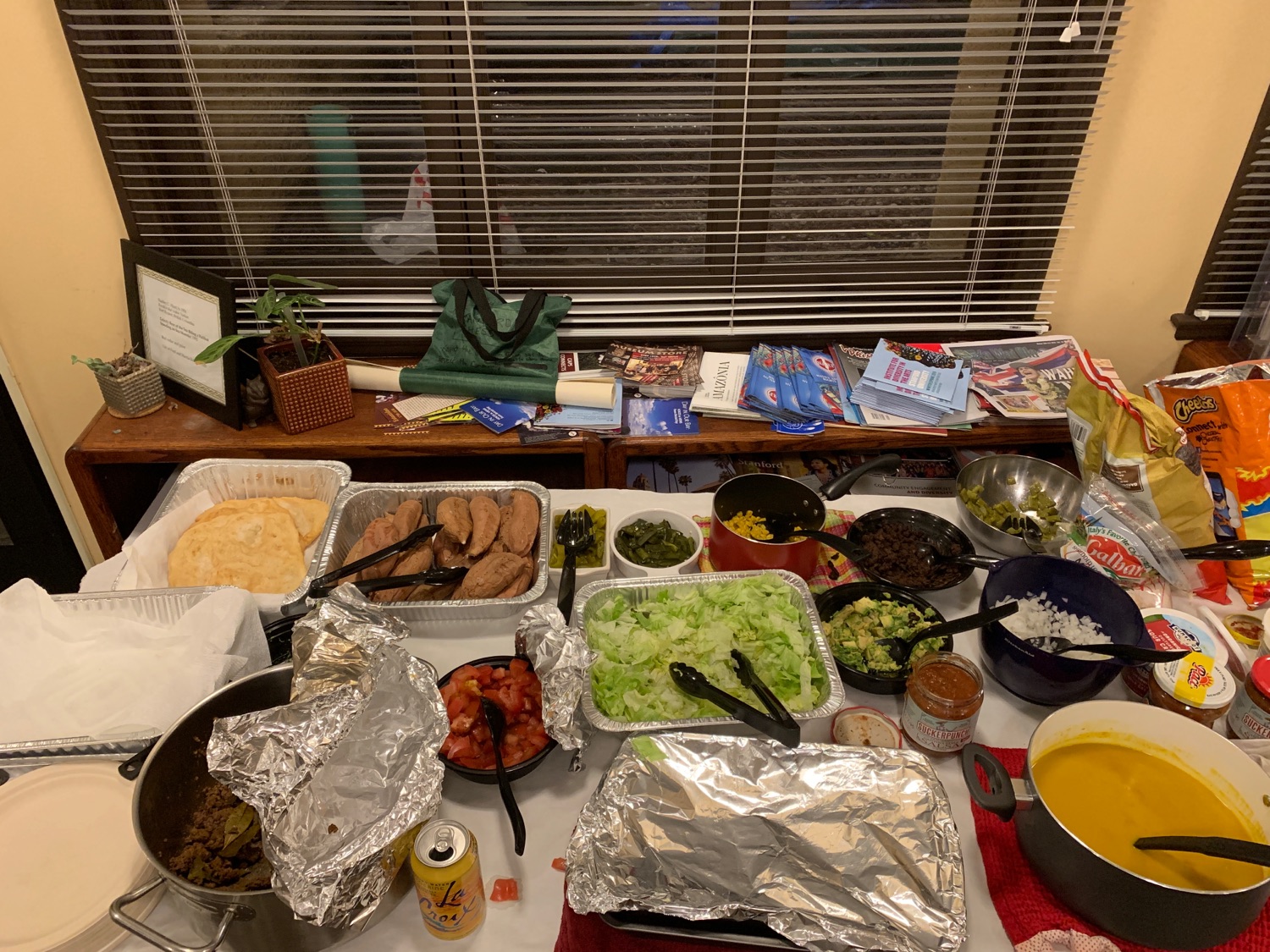
I went to the SNAGS - BioAIMS Frybread Dinner at the Native American Cultural Center on Friday, March 8, 2019, and it was a great way for me to connect with current Native grad students and network and all of that fun stuff. I helped shape some of the frybread there, and I was asked to give a food/water blessing too, so I got to do that. It seemed like really fancy ingredients like it was delicious gourmet à-la-mode c’est la croix on pointe du jour or whichever they call it but was good nonetheless. I rated it a 10/10 on Yelp. It was a very nice and wholesome experience


Event 2: Alternative Spring Break Class EDUC96

Throughout the quarter, I have been involved with Alternative Spring Break, which is a community service program that runs through Spring Break, and I co-lead our ASB trip with Gracie Young (Griffin's sister for those who know him), and we do a variety of activities with our 10 students, such as a Kahoot we did, talking with people actively engaged in digital language revitalization, learning the Cherokee language, and dedicating most of our time creating paper prototypes of Cherokee language learning apps that the students will demo at New Kituwah Academy and Cherokee Central Schools on the Eastern Band of Cherokee Reservation next week. Our students have made a lot of progress on the prototypes, and they will be able to use the skills learned and utilized in class for whatever major they decide to do. (You shouldve signed up for our ASB it was LTE, plus we had 波霸奶茶 on the last day)


Thursday, March 21, 2019

Adam's Final Project - Panbread

For my final project, I made panbread for everyone (in Shoshone, neme tekkappeh, in Paiute, numu tukabu, sometimes called Indian Bread, I guess up north in Canada (BC, AB) they call it Bannock), which is the old-school way to make bread besides ash bread, which you would still find in southern Utah/Arizona, and it actually predates the frybread that we eat. My grandparents taught me how to make this bread, and I got better with practice. You can eat it for dinner, usually we have it for hamburger potatoes, sometimes spaghetti, or when we make beans, you can eat it for lunch, and you could make a breakfast sandwich out of it.

This is a food that's not really cooked that much anymore since everyone just makes frybread all the time, but it's usually the older ones that still make it. You'd need a really strong oven to cook it because you have to cook it at 500 for about an hour. It was hard to make it in the Muwekma kitchen since there's no broil option 😪😪 but it was a fun experience sharing bread with all of you, glad you all liked it

Sunday, March 17, 2019

Final and 2 events -Corey

I attended the Snotty Nose Rez Kids Lunch talk and Peter Williams Dinner talk at the NACC. I didn't get a chance to take pics.

As for my final project. I have been making music lately and I made a song called Kill the Man, Save the Indian. It is a metal song about Native people's relationship with colonization and reclamation of identity. In that way you are killing the "man" to save the "Indian", instead of the other way around.

Here is a link:

https://drive.google.com/file/d/1dZSnOw3jCI91pRVLUs9NXCChDGlYuEJS/view?usp=sharing

Friday, March 15, 2019

Alicia Final

I know I said id write about traditional Yup’ik regalia but I thought the history behind my name/Yup’ik names, in general, was more interesting.

A year before I was born, my grandmother passed away. My mom being the youngest child of nine siblings took this loss the hardest. She was roaming this world without direction and needed a reason to pick herself back up again. She tells me she prayed to God and asked him to give her a baby girl. That same year, my mom got pregnant with me. When I was born, she named me Alicia Christina Nugarrluk Evan. Alicia is a derivative of my grandmother's name, Alice. My middle name, Christina, came from my grandmother’s mom who was Christine. My Yup’ik name is the exact same Yup’ik name as my grandmother's Yup'ik name. In my culture, if you are named after someone, you are their namesake. So even after that person passed, you sort of carry their name and role. So for me, being named after my grandmother,  gave me some of her roles. There are people who refer to me with the same relation that they had to my grandmother. For example, if my grandmother was their aunt, I am now their aunt too. My mom tells me that when my grandmother died, she had a hole in her heart but since I am named after my grandmother, I filled that hole. Recently, I asked her what my name would be if I was a boy and she told me she never picked a boy name or even though about it because she knew I would be a girl. When my mom had my younger sister, she knew exactly what her Yup’ik name would be. Her Yup’ik name is Cingarrkaq. This name is after my grandpa. My sister is seen as my grandfather's namesake. My mom always tells us that she has her mom and dad with her because my sister and I are their namesakes. My name is a significant part of my identity. I carry this name with respect because even though I never met my grandmother, I know she is with me every step of the way.

This naming system is commonly seen in the Yup’ik culture. Normally, people are named after only the deceased. Example, when someone is pregnant, even if a name was picked for that child, if someone suddenly dies in the family, the parents will name their child after the person who passed away. This is a commonly seen trend in the Yup’ik culture, and when I have children, they will most likely be named after someone too.

Two events-Alicia

(I don't have any pictures)

I attended a kickback at the NACC hosted by the Hawaii Club. There was an array of local Hawaiian foods for everyone to enjoy. We all sat, ate, talked, and watched the song contest on TV. It was a very chill time.

The second event I attended was the Nainoa Thompson talk at the NACC & CEMEX Auditorium. At the NACC, we all ate lunch and heard him tell stories about his life and his journey to becoming a Pwo navigator. Along with him, his daughter also spoke and told stories. At CEMEX, it was a more formal event where he was on stage giving a presentation. He went into depth and gave a very moving presentation.

Final Project - Cooking
I made Indian Tacos, which were adopted into Mohawk food culture during the 70s-90s when POWWOWs began to become a thing in Kahnawake. We make the bread differently, and incorporate beans and other vegetables to our chili sauce to make the tacos more of our own (Mohawks are agricultural people, traditionally)

Thursday, March 14, 2019

Final Project- Foster

For the final project, David and I made Wojapi, which is a berry pudding. Traditionally it is made from chokecherries, wild blueberries, buffalo berries, etc, this that are found in the plains region; but we made it out of normal blueberries which is more common today since it is more accessible.

Wednesday, March 13, 2019

Final Essay - Michael S.

Cedar

In class, I mentioned how I would be writing about my cedar, what I use it for, and what it signifies to me. First of all, for those that don’t know what cedar is, it’s a small, rough, grainy, dark green needle (from a cedar tree) that has a very potent smell. To me, the cedar itself smells good, but once it is burned, it smells even better. As mentioned earlier, the cedar itself comes from the cedar tree which is pretty common on the Navajo Nation, or at least in Kayenta. Most people don’t pick their own cedar because it would take a while to collect an abundance of it, so instead people buy it from the flea market in hand size bags.

Cedar can be used for various reasons in various settings, but the main purpose of it is to bring goodness. Most people, such as myself, use cedar to pray and again, the idea behind it is to bring goodness not only into your life, but also for your family and friends. Cedar can be burned on pretty much anything, but for me, I grew up watching my mom use a small skillet. I start by getting the skillet, placing it over a hot surface such as a stove, grabbing a pinch (or more) of cedar, and placing it on the skillet. The cedar will then make a crackling sound as it is burned, going from dark green to black, and smoke will arise during the process. As this is happening, I usually talk/pray towards the smoke and the idea behind this is that the smoke will carry your words and everything you prayed for up to/towards shídiyin (God). I was also told that smelling cedar will clear your head of all bad thoughts and fill it with good thoughts.

Thursday, March 7, 2019

Regina's Final Essay

Contemporary Native American Identity Through Art

Natani Notah is an artist who uses her work to explore contemporary Native American identity, and in particular Diné womanhood. She emphasizes the importance of knowing where you come from and being grounded by your family—citing acts of decolonization, Indigenous feminism, and indigenous futurism as further sources of inspiration. Through her art, she examines the impacts of colonialism and uses materials in her pieces that have a history of contamination and exploitation. By bringing together items that may not fit together, such as the stereotypical portrayal of a Native American woman on a Land O’Lakes mug to a fine art gallery, Natani challenges the viewer to think deeply about the way that we are influenced by images. 

One work that had a significant impact on me was Natani’s film, “I Cut My Hair.” In the film, she wears a plain, white t-shirt and a dusty pink long skirt. She sits in front of a tan door and cuts her hair piece by piece while performing a monologue for missing and murdered indigenous people. I was very moved by how Natani chose to shed light on a critical and urgent issue through art. What art allows for is an unrestrained, fearless perspective on the world. What can’t be said in everyday conversation is given greater complexity through creative mediums.

Natani works across several mediums, from painting to film to poetry to sculpture and beyond. Another work I really enjoyed was her “Standing Rock Collages” in which she took photographs from the Dakota Access Pipeline protests and pasted them onto white paper. She then cut out tan speech bubbles but left them blank. What results are visually striking, powerful images that say so much without literally saying anything at all. 

Although Natani is an interdisciplinary artist, she is most of all a storyteller who uses her art to highlight Native narratives that are often overlooked by mainstream media. She seeks to confront the dominant patriarchal and colonial dialogues in the United States by inserting a female Native perspective. Dealing with topics such as intergenerational trauma, Natani facilitates collective healing and reconciliation through her artwork. 

I am immensely inspired by the thought and creativity Natani puts into her work, as well as her ambition to use her work to comment on issues of identity and culture. I think that people like Natani are doing such important work for our society today, and I’m so excited to see where else she takes her art to.   


Wednesday, March 6, 2019

Two Events- David Espi

Lakota Dinner 2/17 
Lakota dinner is a dinner that happens every quarter and consists of students in SpecLang 247, otherwise known as Lakota language. At Lakota dinner, we go over introducing our selves in Lakota to whomever our special guests are, showing off what we are learning. After that we eat a traditional-contemporary Lakota meal which is soup, wojapi, bread, and mint tea for a beverage. At this particular dinner the soup was buffalo chili with blueberry wojapi (pudding) and ceyaka (field mint tea). I seemed to gain a lot of energy from being in this space and eating the food. It was sort of a spiritual energizer for me. The chili was phenomenal, as well as the bread and wojapi. Anytime I drink ceyaka is a great time to me, so in return, this event was wholesome and was very powerful for me.


Mentor Dinner 2/28
The mentor dinner was a dinner to invite your personal mentors, people who have affected your life positively, to come enjoy a tasty "indian taco". Which is a contemporary staple that derives from government rations given during and through the establishment of reservations. The food was prayed for in two different languages as well as sang for in three others. There were awards that were handed out later throughout the night. I really enjoyed this event because the food was great as well as the SAIO members who gave speeches. In particular, Gabi Saiz had a really interesting speech that inspired me. All in all it was a great event with great people.


(No photos: Foster posted one from Lakota Dinner)

Two Events - Michael S.


Above are the two events I attended this quarter. The left picture was an event held by the Department of Art & Art History where Wes Studi (the guy by me) had a conversation with Alexander Nemerov (a Stanford professor). The conversation started with Wes Studi sort of talking about his character in Last of The Mohicans and how he went about acting for it. The conversation then shifted to Wes Studi’s personal life and he talked a little about his involvement in the American Indian Movement. Overall, I really liked this event and gained some insight on the American Indian Movement from Wes Studi.

The picture on the right was the Annual Native Student and Mentor Dinner held at the Clubhouse Ballroom. Not only was the food very delicious, but I also got the chance to meet new people/mentors. I liked how there was a diversity of people there in terms of undergrad students, graduate students, professors, and mentors. As a freshman, this event was very beneficial and overall I really enjoyed it.

Tuesday, March 5, 2019

Two Events - Riio

(No photos for the events, but Justin can vouch for my first one)

1: Katie Cromack
        I attended this event on February 4th, and listened to Katie talk about her experiences at Stanford as a student, as well as her life after leaving Stanford. It was reassuring to hear her talk about how even after she graduated, she didn't necessarily know what she was doing. She talked about how there is a lot of pressure on Stanford students to have these amazing accomplishment upon and after graduation, but that it is unrealistic. I think going to this talk was really refreshing and comforting because I was able to hear that my worries are legit. But, that I shouldn't really worry all that much about them.
       She talked a lot about her job and how she got to the career she is in now. It was nice to hear about her journey, and I was very interested by how she found what she loves (a career that has nothing to do with her undergrad degree). It was just a really nice, reassuring talk/event.

2: Petition
       As you guys know, I organized the petition to correct Prof. Kenneth Fields' class on Native American Myth, Legend and Lore. There were a lot of events and planning involved in this, and one of the meetings was open to the public. There, we discussed with the English Dept., NativeAM Dept., and Creative Writing Dept. how we could move forward after everything that went down. It was cool to talk to the heads of each department and have input on how we want to further Indigenize the campus. I really liked being able to organize and help bring voice to the students of the Native community here at Stanford. It was a good one.

Thursday, February 28, 2019

Regina's two events!


[Above] A photograph from Natani Notah's performance piece #TSIIYÉEŁPOWERED. Notah is a Native artist whose work focuses on missing, murdered and indigenous women as well as her family's own history. She got her MFA from Stanford and came to the Harmony House earlier in the quarter to give a talk. The performance piece was filmed and shows Notah wearing three TSIIYÉEŁs.I was really inspired by Notah, especially when she shared with us how she uses social media to bring awareness to these important issues. (She's the one who started the "and Native Americans") social media movement.

[Below] Nanoia Thompson's talk (featuring Vance!).  I really enjoyed listening to Thompson speak about how his Native Hawaiian heritage connected with his passion for the earth. One part of his talk that really struck me was when he talked about how Native Hawaiian history carries so much shame. It made me think about the consequences of intergenerational trauma and how pain and suffering can be passed down along family lines. Also, Thompson's journey—both physical and personal—really moved me. 


Foster- Two events


Here are my two events that I attended. On the left is a picture of David eating Delphines Buffalo Chili, Cherry Wojapi, and fry bread for the Lakota Traditional Dinner. It was a fun time eating such amazing food and being around Lakota elders that were there. On the right is Brett Shelton (Oglala Lakota) who is a peacemaker of the Native American Rights Fund NARF. He talked about the work that he does and this specific project he helped with on the Pine Ridge Rez which worked on incorporating the Lakota language and culture into policy and law.

Wednesday, February 20, 2019

2/20/19 Hawaii History Make-up

For those who did not attend tonight's House Sem, please watch this short documentary on Nainoa Thompson. What did you learn? What are you thoughts?

https://www.pbs.org/video/long-story-short-leslie-wilcox-nainoa-thompson/

200-250 words.

Thursday, February 14, 2019

MMIW make up

For those who did not attend the MMIW panel, please watch this 35 min video on Missing and Murdered Indigenous Women called Our Sisters In Spirit. What did you learn? What are your thoughts? Link: https://www.youtube.com/watch?v=zdzM6krfaKY
200-250 words.

Naturally Native part 2

For those who weren't in class when we finished Naturally Native we talked about how the movie touched upon issues such as alcoholism, MMIW, growing up on the reservation v not (urban), tribal sovereignty, selling your indigeneity, tribal enrollment numbers, etc. We also came to the conclusion that this movie sort of beat around the bush when it came to these issues. If you were to update the movie now, what would that look like? OR What native issues would you include in the movie that weren't touched upon. 
If you were at the discussion at the end of class you do not have to respond. But if you have more thoughts we'd love to hear them :) 

Wednesday, January 23, 2019

Naturally Native part 1

We will be watching the rest of the movie next class! 

For this prompt please write about/identify some of the stereotypes/issues that you saw in the movie related to Native identity. Feel free to include personal experience. 200-250 words 

Sunday, January 20, 2019

Video Reflection

Hi everyone! 
Thanks for a good first session last Wednesday. Please respond directly to this post as a comment before our next meeting. The prompt is to simply reflect/respond to the two videos we watched at the end of class. Word count 200-300 words. 
Here are the links to the vids: 
Alcatraz: https://www.youtube.com/watch?v=TBjuhFOeitE
UN Indigenous Language: https://www.maoritelevision.com/news/regional/2019-international-year-indigenous-languages


Wednesday, December 12, 2018

Event- Kauaenoe Batangan Talk

A few reflections on the talk:
I would say one of the most interesting things to me during the talk was hearing how he engaged in policy in a meaningful way without having a direct path. Policy has always interested me, but I never felt aggressive enough, or full enough of righteous indignation to take on that path, but he seemed like a super chill and upstanding person, so maybe that is possible in politics! I guess I have to rethink my life now! I really appreciated the fact that he was so upfront about the path that his life followed and that the constant flux of life doesn't stop after college. it felt like when you read one of those relatable teen novels when you're sixteen and everything feels profound, because you feel more connected to the ~human experience~. It was really reassuring to me, even though I front like I'm not TERRIFIED of the future, I do worry about it some times.
It was also interesting to see how he did something that he really cared about and incorporated his identity into how he wanted to make change in the world. I also appreciated hearing about how his experiences as an undergrad shaped him. I thought it was even better that it was experiences and not classes that did the shaping!